- Soit
 la fonction définie sur
 ![]0;+\infty[](https://spe-maths.fr/wp-content/ql-cache/quicklatex.com-80243cc86f99e2d74411fff3ccaa6a1e_l3.png "Rendered by QuickLaTeX.com") par :
par : 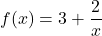 et
et  sa courbe représentative dans un repère orthonormé d’unité
  cm.
cm.
Calculer l’aire sous la courbe sur l’intervalle ![[1;4]](https://spe-maths.fr/wp-content/ql-cache/quicklatex.com-7d47d6bab2b045a261fb0309c3d5a687_l3.png "Rendered by QuickLaTeX.com") .
.
La fonction est est continue sur en tant que somme de fonctions continues sur cet intervalle.
Ainsi l’aire sous la courbe sur l’intervalle est :
Or cm
cm
Donc :

Exercice 2
est continue sur en tant que somme de fonctions continues sur cet intervalle.Ainsi l’aire sous la courbe
sur l’intervalle est : ![<span class="ql-right-eqno"> </span><span class="ql-left-eqno"> </span><img src="https://spe-maths.fr/wp-content/ql-cache/quicklatex.com-7264c27f14ae022d6996502b2a7e6afd_l3.png" height="168" width="241" class="ql-img-displayed-equation quicklatex-auto-format" alt="\begin{align*} \mathscr{A}&=\displaystyle \int_1^4 f(x)dx \\ &=\Big[3x+2\ln(x)\Big]_1^4 \\ &=12+2\ln(4)-\left(3+2\ln(1)\right) \\ &=12+2\ln(4)-3\\ &=9+2\ln(4)\text{ u.a.}\end{align*}" title="Rendered by QuickLaTeX.com"/>](https://spe-maths.fr/wp-content/ql-cache/quicklatex.com-34d88f922619fa98c001303aedbba184_l3.png "Rendered by QuickLaTeX.com")
Or
cmDonc :
Soit  la fonction définie sur
  par
par  .
.
Calculer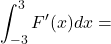 :
:
Correction
la fonction définie sur par .Calculer
:
On a :
Exercice 3

Calculer La valeur moyenne sur ![[-2;1]](https://spe-maths.fr/wp-content/ql-cache/quicklatex.com-d52ba7540794bbf65e3a50e1f91136d3_l3.png "Rendered by QuickLaTeX.com") de la fonction définie par
de la fonction définie par  .
.
Correction
de la fonction définie par .
La valeur moyenne d’une fonction sur est donnée par la formule
sur est donnée par la formule ![\[m=\dfrac{1}{b-a}\displaystyle \int_{a}^b f(x)dx\]](https://spe-maths.fr/wp-content/ql-cache/quicklatex.com-d6dbcbd10757aac505b71788d7220ac6_l3.png "Rendered by QuickLaTeX.com")
![<span class="ql-right-eqno"> </span><span class="ql-left-eqno"> </span><img src="https://spe-maths.fr/wp-content/ql-cache/quicklatex.com-12c6ba3a378da4d02ea25716bf7205aa_l3.png" height="199" width="190" class="ql-img-displayed-equation quicklatex-auto-format" alt="\begin{align*} m&=\dfrac{1}{1-(-2)}\displaystyle \int_{-2}^1 3x^2dx \\ &=\dfrac{1}{3}\Big[x^3\Big]_{-2}^1 \\ &=\dfrac{1^3-(-2)^3}{3} \\ &=\dfrac{1+8}{3} \\ &=3\end{align*}" title="Rendered by QuickLaTeX.com"/>](https://spe-maths.fr/wp-content/ql-cache/quicklatex.com-e39f095eb22fd19229e9f81b759dacd4_l3.png "Rendered by QuickLaTeX.com")
 et
et  les fonction définies sur par :
  et
et  .
.L’aire du domaine situé entre
et  sur
sur ![[-5;2]](https://spe-maths.fr/wp-content/ql-cache/quicklatex.com-bc59535890fb6845d12a2215cf1c4b6e_l3.png "Rendered by QuickLaTeX.com") est :
est :a.
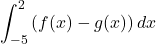
b.
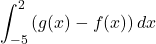
c.

d.

Correction Question 6
et sont deux fonctions continues sur donc  et
et  le sont aussi.
Il faut déterminer le signe de  sur .
sur .
Pour tout réel  on a :

est un polynôme du second degré dont le coefficient principal est  et les racines sont
  et
et  .
.Par conséquent
 sur .
sur .Ainsi l’aire du domaine situé entre
et sur est : ![<span class="ql-right-eqno"> </span><span class="ql-left-eqno"> </span><img src="https://spe-maths.fr/wp-content/ql-cache/quicklatex.com-f37184b4765d9cce63541e29bbe22155_l3.png" height="285" width="315" class="ql-img-displayed-equation quicklatex-auto-format" alt="\begin{align*} \mathscr{A}&=\displaystyle \int_{-5}^2 \left(g(x)-f(x)\right)dx \\ &=\int_{-5}^2\left(-2x^2-6x+20\right) dx \\ &=\left[-\dfrac{2}{3}x^3-3x^2+20x\right]_{-5}^2 \\ &=-\dfrac{16}{3}-12+40-\left(\dfrac{250}{3}-75-100\right) \\ &=-\dfrac{266}{3}+203\\ &=\dfrac{343}{3}\end{align*}" title="Rendered by QuickLaTeX.com"/>](https://spe-maths.fr/wp-content/ql-cache/quicklatex.com-08a041c6ba2c5e40569f792cae489bd7_l3.png "Rendered by QuickLaTeX.com")
Réponse b. et c.
de  sont :
a.
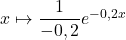
b.
 avec
avec  réel
réelc.

d.
 avec réel
Les primitives sur
de sont de la forme 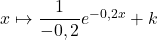 avec réel.
Si
 alors on obtient la fonction définie sur
 De plus on a
 .
.Ainsi les primitives sur
de sont de la forme avec réel.Réponse a. et b.
de  est :
est :a.

b.

c.

d.
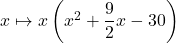
Correction Question 8
On note la fonction définie sur par  .
.
Ainsi
La fonction est continue sur en tant que polynôme.
Les primitives de la fonction sont donc les fonctions définies par  où est un réel.
Si on développe l’expression a. on obtient un polynôme de degré . Cette réponse ne convient donc pas.
Si on développe l’expression d. on obtient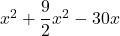 .
.
Réponse c. et d.
la fonction définie sur par .Ainsi

La fonction
est continue sur en tant que polynôme.Les primitives de la fonction
sont donc les fonctions définies par où est un réel.Si on développe l’expression a. on obtient un polynôme de degré
. Cette réponse ne convient donc pas.Si on développe l’expression d. on obtient
.Réponse c. et d.
[collapse]
la fonction définie sur par  .
.La valeur moyenne de
sur ![[-2;0]](https://spe-maths.fr/wp-content/ql-cache/quicklatex.com-21be214f0c14c68e3dc7eff374f79591_l3.png "Rendered by QuickLaTeX.com") est :
est :a.

b.

c.

d.

La valeur moyenne de sur est :
![<span class="ql-right-eqno"> </span><span class="ql-left-eqno"> </span><img src="https://spe-maths.fr/wp-content/ql-cache/quicklatex.com-f5a45eecdfc816aafa735bd76af477fb_l3.png" height="177" width="198" class="ql-img-displayed-equation quicklatex-auto-format" alt="\begin{align*} m&=\displaystyle \dfrac{1}{0-(-2)}\int_{-2}^0 f(x)dx \\ &=\dfrac{1}{2}\left[x+e^{-x^2/2}\right]_{-2}^0 \\ &=\dfrac{1}{2}\left(1-\left(-2+e^{-2}\right)\right) \\ &=\dfrac{3-e^{-2}}{2}\end{align*}" title="Rendered by QuickLaTeX.com"/>](https://spe-maths.fr/wp-content/ql-cache/quicklatex.com-7e63f45fca069293c89ac23957eb0ad0_l3.png "Rendered by QuickLaTeX.com")
Réponse a.
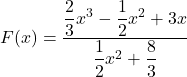
définie sur par : 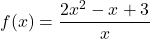 est :
est :a.
b.

c.

d.

Correction Question 10
Pour tout réel appartenant à on a :
Ainsi les primitives de la fonction sont définies par  où est un réel.
Réponse d.
appartenant à on a : 
Ainsi les primitives de la fonction
sont définies par où est un réel.Réponse d.
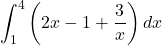 est égal à :
a.

b.

c.

d.

Correction Question 11 On a :
![<span class="ql-right-eqno"> </span><span class="ql-left-eqno"> </span><img src="https://spe-maths.fr/wp-content/ql-cache/quicklatex.com-a27adc7d15d9782c991f4db6850946df_l3.png" height="187" width="306" class="ql-img-displayed-equation quicklatex-auto-format" alt="\begin{align*} I&=\displaystyle \int_1^4\left(2x-1+\dfrac{3}{x}\right)dx \\ &=\left[x^2-x+3\ln(x)\right]_1^4 \\ &=16-4+3\ln(4)-\left(1^2-1+3\ln(1)\right) \\ &=12+3\ln(4)\\ &=12+3\ln\left(2^2\right) \\ &=12+6\ln(2)\end{align*}" title="Rendered by QuickLaTeX.com"/>](https://spe-maths.fr/wp-content/ql-cache/quicklatex.com-9dad35793bb57b7b4c55684578f3c70c_l3.png "Rendered by QuickLaTeX.com")
Réponse a.
[collapse]